Which member of your team is the one with the ‘high performer’ reputation? I’m guessing the answer comes to you almost automatically. Most teams have at least one.
Sometimes we find the high performer’s standard drops.
We find ourselves surprised. Usually we ask, “What happened to them?”
I think that the “surprised” reaction is worth pausing to consider. The high performer reputation is established by how well a person’s strengths, commitment and role are aligned at a given point in time. And it gets carried long after that original fit has shifted.
As the role expands, the high performer invests greater effort to cover the gap - until someone notices or the effort is no longer sufficient. Conversely, they may have outgrown the role and performance drops. The visible outcome may be the same, but the underlying cause isn’t.
So, how do you know whether your organisation is making best use of the capabilities across your team?
In my experience, it’s one of the hardest questions for senior leaders to answer.
We notice the gaps when something is missing, and we respond by recruiting new expertise and (if there’s time) developing current team members.
It’s much harder to spot the situations where relevant capabilities exist but aren’t being deployed in the pursuit of current priorities. Sometimes that’s because people develop at a rate faster than the work changes. Other times, the work evolves more rapidly than the team can respond.
We often reduce this to whether we have development plans in place for each team member. But it’s more than that.
At the system level, it’s about whether we consistently match each team member's capabilities to each role's needs over time.
There are at least four possibilities.
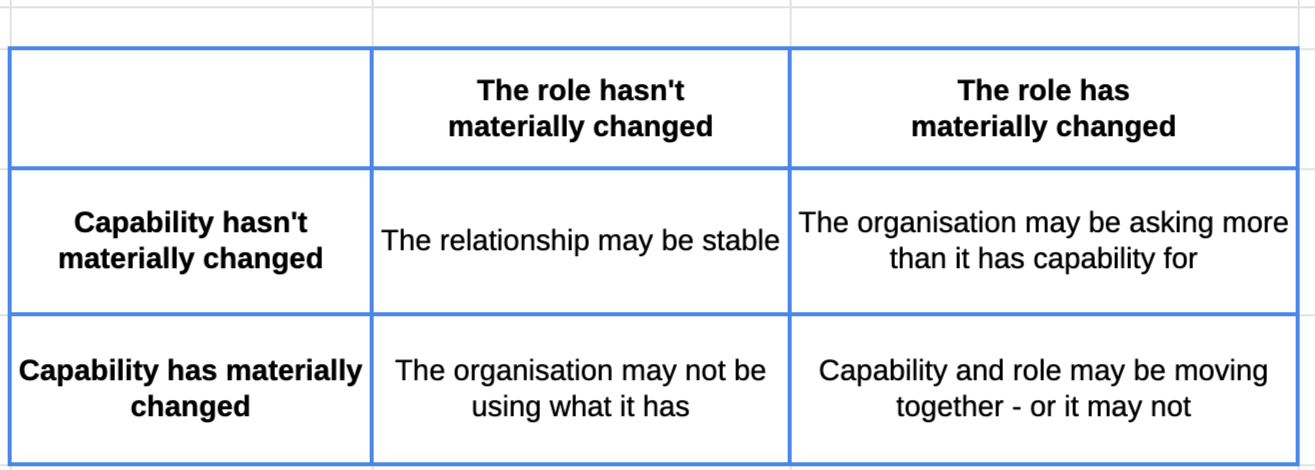
None of these options is inherently bad.
A material change in a role may provide a valuable development opportunity. It can also be a signal that we’ve missed an opportunity to introduce the support and structure required as the expectations have shifted.
Conversely, in people-focused cultures, we encourage individuals to pursue development areas of their choosing. They won't always be in the arenas that are most relevant to their current role.
Even when capability and role look like they’re moving together, the fit may depend on the stability of the context. When the context shifts, it can unsettle the fit without much else changing.
The challenge of ongoing alignment is a significant one. It’s not about fitting people to roles and leaving them there. It’s about recognising the movement of capability and need in real time.
Both mismatches carry a cost. When capability is underused, we’re paying for expertise and not getting appropriate value from it. When role demands outpace capability, individual effort usually compensates for a systemic gap. That’s hard to see and even harder to quantify.
When we see or sense a mismatch, our instinct is to act, using all the tools we have. Create development opportunities, redesign teams and roles, hire a new person. Each option is reasonable. The challenge is that we can end up trying to solve a gap we don’t really understand.
Two questions are worth keeping in view: whether the work has been designed to use the people we have, and whether capability around that work is keeping pace with what the organisation now needs. Neither is answered once. Capability and need keep moving, and the fit between them is something leaders return to rather than arrive at.